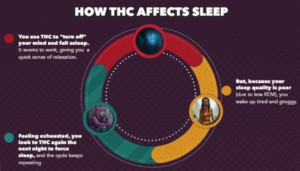
If you’ve ever reached for THC to wind down after a long day, you’re not alone. A lot of youth and adults turn to cannabis to fall asleep, feel that fast wave of relaxation, and assume it’s buying them a deep, restorative night. But real sleep isn’t one long uniform state — it’s a careful sequence of distinct cycles across roughly eight hours.
A healthy night moves through three main phases: light sleep (N1/N2), which makes up about half the night as a steady transition stage; slow-wave sleep (SWS), the deep physical-repair phase concentrated early in the night, when the brain clears metabolic waste and restores energy; and REM sleep, which dominates the early morning hours and handles memory consolidation, emotional processing, and stress regulation. Your body is built to prioritize physical recovery first (SWS) and mental restoration later (REM).
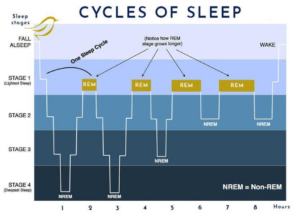
THC throws off that timing. Research going back to the 1970s has consistently found the same basic pattern: THC nudges the brain toward more early-night deep sleep while cutting into REM. It works like a kind of biological loan — borrowing time from the REM sleep you’d get later in the night to fund the heavy, sedated feeling you get early on. Because that heaviness feels like “good sleep,” it’s easy to wake up assuming you got a full, restorative night, even when your sleep pattern didn’t cooperate.
High school students (ages 12–18)
Teenage brains naturally produce a lot of deep slow wave sleep (SWS). But, adolescence is a crucial time for brain maturation, emotional development, and learning — all processes that lean heavily on REM. When THC pushes more of the night into deep SWS sleep, it likely comes at REM’s expense, squeezing it into shorter, later bursts.
Most of the direct research on teens and cannabis has focused on how much they sleep rather than the stages themselves, and it tells a consistent story: teens who use cannabis to help them sleep tend to get less sleep overall, and that pattern often ties to broader sleep and substance-use struggles. Put together with what we know about how THC affects sleep architecture in adults, the result is what shows up in classrooms every day — daytime anxiety, emotional ups and downs, poor impulse control, and trouble retaining what’s learned. It often gets written off as moodiness or a lack of effort, when a REM deficit may be quietly doing the damage.
Young adults (19–30)
Studies comparing regular cannabis users to non-users in their late teens and twenties have found measurably lower REM sleep in users, along with a longer delay before REM kicks in. That matches what a lot of young adults report doing in the first place — using cannabis specifically to fall asleep faster, which is exactly the setup for this trade-off to go unnoticed.
Because young adults depend on that late-stage REM for problem-solving, cognitive flexibility, and focus, losing it tends to show up the next day as real friction — the “brain fog,” sluggish decision-making, and trouble managing a full workload that often gets blamed on being busy or stressed, when a shortchanged REM cycle may be part of the story.
Adults 30+
Some of the shift in brain sleep cycles happens with age alone, no cannabis required. As we get older, our brains naturally produce less deep, slow-wave sleep and somewhat less REM. An adult over 30 simply isn’t going to generate the deep sleep of a teenager, THC or not.
Add THC into that picture, and it tends to behave less like a restorative aid and more like a sedative — extending light sleep while chipping away at an already-shrinking REM time. Losing that REM time is linked to weaker memory recall, less mental sharpness, and reduced emotional resilience. In daily life, that can look like chronic morning fatigue, shorter patience, and the kind of slow-burn exhaustion a lot of adults just chalk up to getting older — when their nightly gummy may be part of the equation.

The takeaway
The research on THC and sleep spans fifty years, a wide range of doses, and study designs — so no single number tells the whole story, and the newest, lowest-dose products haven’t been studied nearly as much as the classic high-dose trials. But the pattern holds up well enough to take seriously: THC doesn’t create deep sleep out of nowhere, and it doesn’t come free. It mostly borrows from REM, and the people who can least afford that trade — developing teenagers — are also the group we understand the least.
Understanding how THC alters sleep architecture, rather than just how sedated it makes you feel, is the first step toward real restoration instead of just checking out.